
For the first eight months, industrial output, as measured by the index of industrial production, rose by 3.9 per cent against 9.2 per cent in the corresponding period of 2007-08.

The production growth of eight key infrastructure sectors slowed to a six-month low of 7.8 per cent in November due to a decline in the output of crude oil and cement sectors. The growth rate in the production of coal, fertiliser, steel, and electricity also decreased during November this year. According to the data released by the government on Friday, the growth during the month under review, however, is higher than the 5.7 per cent recorded a year ago.
After contracting for the first time in 15 years in October, industrial production again crashed by two per cent in December against a growth rate of a whopping 8 per cent a year ago despite a stimulus package announced by the government to boost sagging demand.

The weakening of inflation, prospects of economic growth, geopolitical uncertainty and comfortable system liquidity may result in the Reserve Bank of India's (RBI) Monetary Policy Committee (MPC) to cut the repo rate by another 25 basis points, opine top economists. They also said the external economic pressures like trade policies and others would require continued RBI's accommodative stance and policy support for the Indian industry to sustain the growth.

Wholesale inflation rate eased to 34-month low of (-) 0.92 per cent in April on easing prices of food, fuel and manufactured items. The wholesale price index (WPI) based inflation has been on a declining trend for 11 months in a row and entered the negative zone in April. In June 2020 WPI was at (-) 1.81 per cent.

Production of eight infrastructure sectors recorded an almost flat growth rate of 6 per cent in February as against 5.9 per cent in the same month last year, according to official data released on Friday. The growth in February is lowest in the last three months. The output of core sectors had increased by 8.9 per cent in January 2023 and 7 per cent in December 2022.

India's manufacturing sector growth started the year 2025 on a strong footing and touched a six-month high in January, fuelled by the steepest upturn in exports in nearly 14 years, a monthly survey said on Monday. The seasonally adjusted HSBC India Manufacturing Purchasing Managers' Index (PMI) rose from December's one-year low of 56.4 to 57.7 in January supported by the fastest upturn in new export orders since February 2011.

Manufacturing, which has around 80 per cent weight in the Index of Industrial Production --a measure of factory output in the country -- rose by 17.9 per cent during the month against one per cent a year ago.

Macroeconomic data announcements, global factors and trading activity of foreign investors would be the key triggers for the domestic stock markets this week, analysts said. Last week, the benchmark indices joined the broader market's party despite a host of negative global cues. In the broader market, the BSE midcap and smallcap gauges hit their all-time highs on Friday.
The Index of Industrial Production (IIP) grew by 10.9 per cent in January this year as against 8.5 per cent in the corresponding month last year.
The industry performed badly during the last month of 2007-08, with growth decelerating to 3 per cent from 14.8 per cent in the year-ago period, a development that could be a major cause for concern for the government that is now focusing on fighting high inflation.

'Invest only in stocks of those companies that deliver on earnings and there is earnings visibility too for the next few quarters.'

During April-August, the eight sectors grew by 4.4 per cent, against 4.2 per cent in the year-ago period.

Industry insiders in India warn that any such move in the pharmaceutical sector could be counterproductive for the US as it may face increased drug shortages if tariffs are imposed on such imports.

Portfolio management services (PMS), catering to higher networth individuals (HNIs), are facing tough competition from emerging alternative investment funds (AIFs), evident from their dwindling client base. In May, the number of clients for the industry stood at 125,390, down 20,528 in two months, shows data from the Securities and Exchange Board of India (Sebi). "PMS managers also have a high active ratio, which means their portfolios are quite differently positioned and more actively managed, compared to the benchmark, which is also a highlight for long-term investors.

Inflation trajectory does not match the slump in demand, prolonged pause on rates likely.
Continuing its dismal performance, industrial growth fell further to 1.9 per cent in September, mainly due to poor output from the manufacturing sector.

During April-September, the eight sectors grew by 4 per cent, against 5 per cent in the year-ago period.
India's industrial output grew 9.7 per cent in August compared to 7.6 per cent in the same month last fiscal.\n\n

India's annual industrial output growth slowed to 4.2 per cent in July compared with an upwardly revised 4.4 per cent growth a month ago, government data showed on Friday.

The IIP data showed a significant slowdown in the manufacturing sector, which grew at 4.2 per cent in July 2019 as compared to 7 per cent a year ago.

Manufacturing, which constitutes around 80 per cent of the index of industrial production, grew 19.4 per cent in April against 0.4 per cent a year ago, according to official data released on Friday.

If growth reverts to the pre-Covid level, a lot of people may have to temper their rosy optimism, points out Debashis Basu.
According to the data released by the government, the capital goods segment in the overall industrial output rose by 63 per cent in July and pushed up the Index of Industrial Production (IIP) by 13.8 per cent.
The country's industrial production has risen by 11.4 per cent in September 2006 over the year-ago month, powered by double-digit growth in manufacturing and electricity sectors.\n
India's industrial production rose 4.9 per cent year-on-year in April, the first month of the current financial year, the official Central Statistical Organisation said on Thursday.

The index could be vulnerable to a bigger fall given the present market dynamics.

The Reserve Bank of India's (RBI's) interest rate decision, West Asia conflict and trading activity of foreign investors are the key factors that will dictate investors' sentiment in the market this week, analysts said. Moreover, quarterly earnings from IT bellwether TCS, domestic macroeconomic data and movement in global oil benchmark Brent crude would also guide trends in the market. Worsening tensions in the Middle East and foreign fund outflows were the major culprits behind the equity markets sharp fall last week.
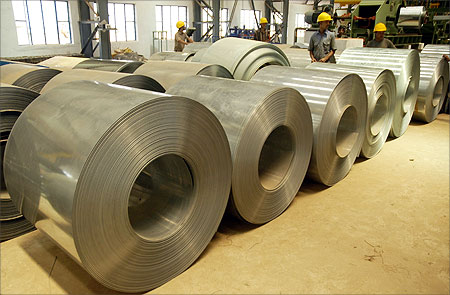
Industrial output fell 3.2 per cent in November.
India's industry sector grew by 6.7 per cent in July 2005 compared to 8.5 per cent in the same month a year ago.
As per use-based classification, primary good registered a growth of 7.4 per cent, intermediate goods 22.4 per cent, and infrastructure/construction goods 0.1 per cent in February 2020 as against the same period a year ago.
The country's industrial output growth trickled to 6.2 per cent in October, the lowest this fiscal, on account of a slowdown in manufacturing production.

Stock markets will be driven by domestic inflation data, ongoing quarterly earnings from corporates and global trends this week, analysts said. News flows around the general election would also be tracked by investors, market experts said.

India's services sector growth touched a four-month high in December, supported by new business inflows on strong demand conditions and easing inflationary pressures, a monthly survey said on Monday. The seasonally adjusted HSBC India Services Business Activity Index, rose from 58.4 in November to 59.3 in December, highlighting the strongest rate of expansion in four months.

Industrial production grows at 2.1 per cent in March.
Inflation, remained in negative territory for the 7th month in May

'The pollution has increased. We are facing breathing problems and irritation in the eyes'

Wouldn't it be better to reach 45 with a backup engine of passive income that helps you glide through these years instead of grinding, asks Ramalingam Kalirajan

The core infrastructure industries had expanded by 5.2 per cent in the previous month.
